L.A.T.R.I.O.
Response Renderer
Clean formatting, even while it generates.
Answers are formatted for easy reading. Maths, tables, and code hold their shape even while they're being written. You can keep reading without waiting for generation to finish.
3 ways to calculate pi
Here's how they compare on speed of convergence and ease of implementation.
| Method | Convergence | Implementation |
|---|---|---|
| Leibniz series | Slow | Easy |
| Monte Carlo method | Slow | Easy |
| Gauss–Legendre algorithm | Very fast | Moderate |
π4 = ∞Σn=0 (−1)n2n + 1
def leibniz(n):
    return 4 * sum((-1)**k / (2*k + 1)
                   for k in range(n))
On Screen
Tables, maths and code, just as they should be.
An answer as L.A.T.R.I.O. actually draws it on the R.E.V.I.S. screen: tables as tables, maths as typeset formulas, and code colour-coded and ready to copy.
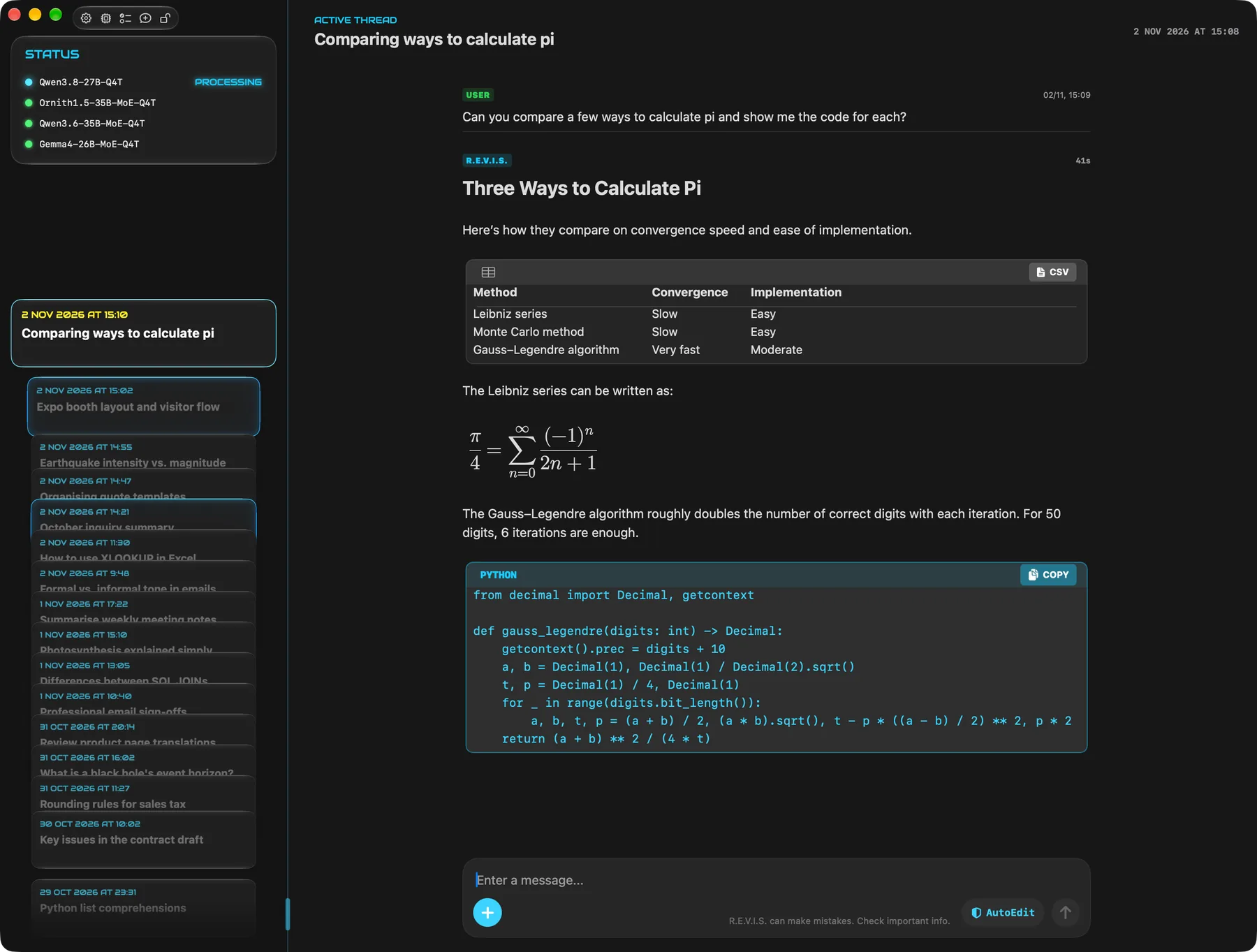
Render While Writing
No need to wait for the end.
Local AI writes its answer a little at a time. L.A.T.R.I.O. formats it from whatever has arrived, so even partway through a table or an equation, the answer grows while staying readable.
Displayed as it's written
Without waiting for generation to finish, it formats headings, bullet lists, and links from whatever has arrived.
Maths, tables, code
Maths as maths, tables as tables, code with syntax highlighting. The typesetting holds even while it's being written.
Smooth, even when long
Even as long answers keep streaming, scrolling and layout don't jump. You won't lose your place.
The Whole Screen
It draws the whole screen.
Not just answers. The tool rows that show the flow of work, the M.μ.X.I.S. task tiles, the server screen. The R.E.V.I.S. interface is drawn by L.A.T.R.I.O.
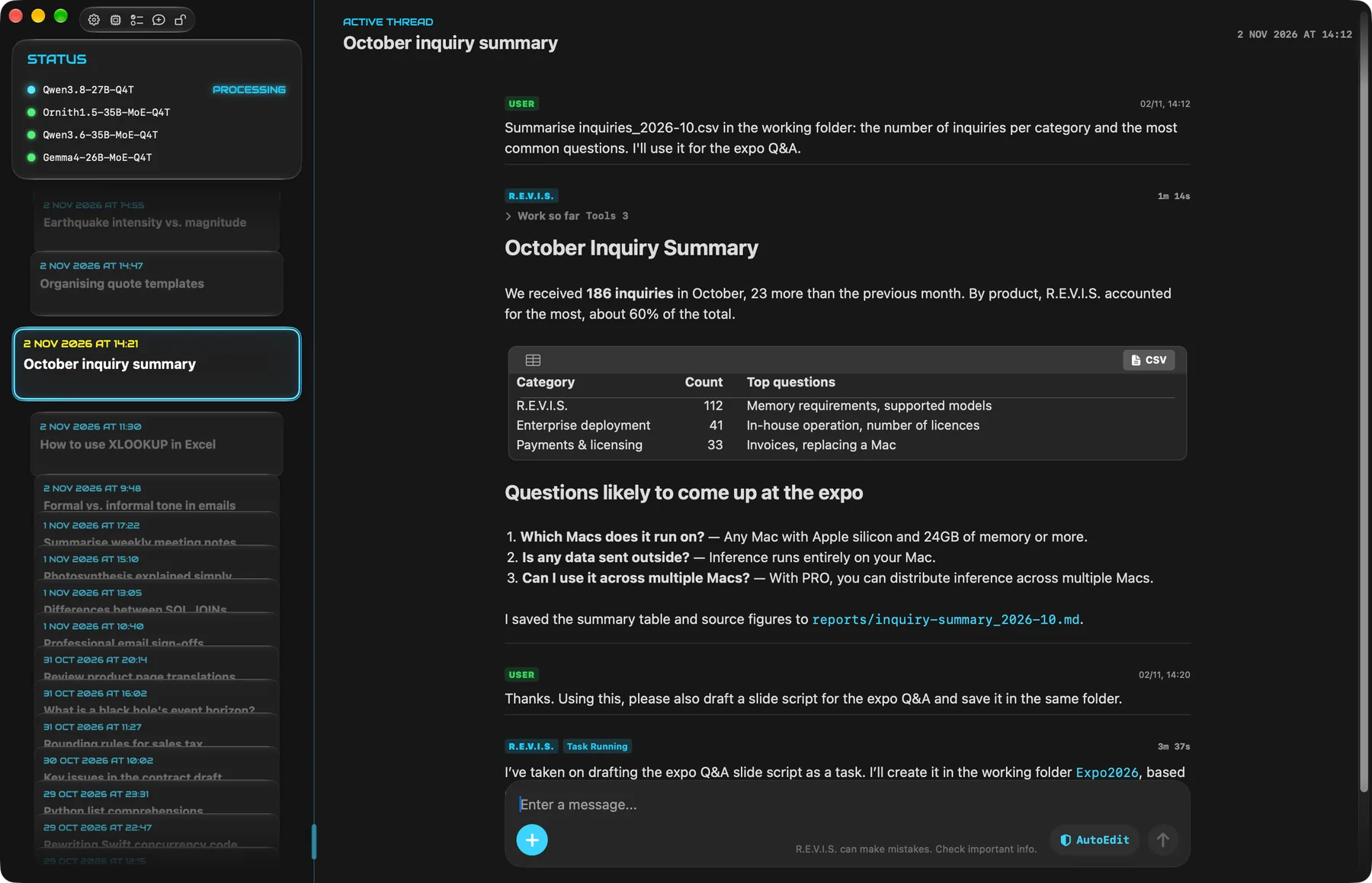
Read the answer without waiting.
Its shape is right from the start.
SEVEN CORES / ONE CONSCIOUSNESS